
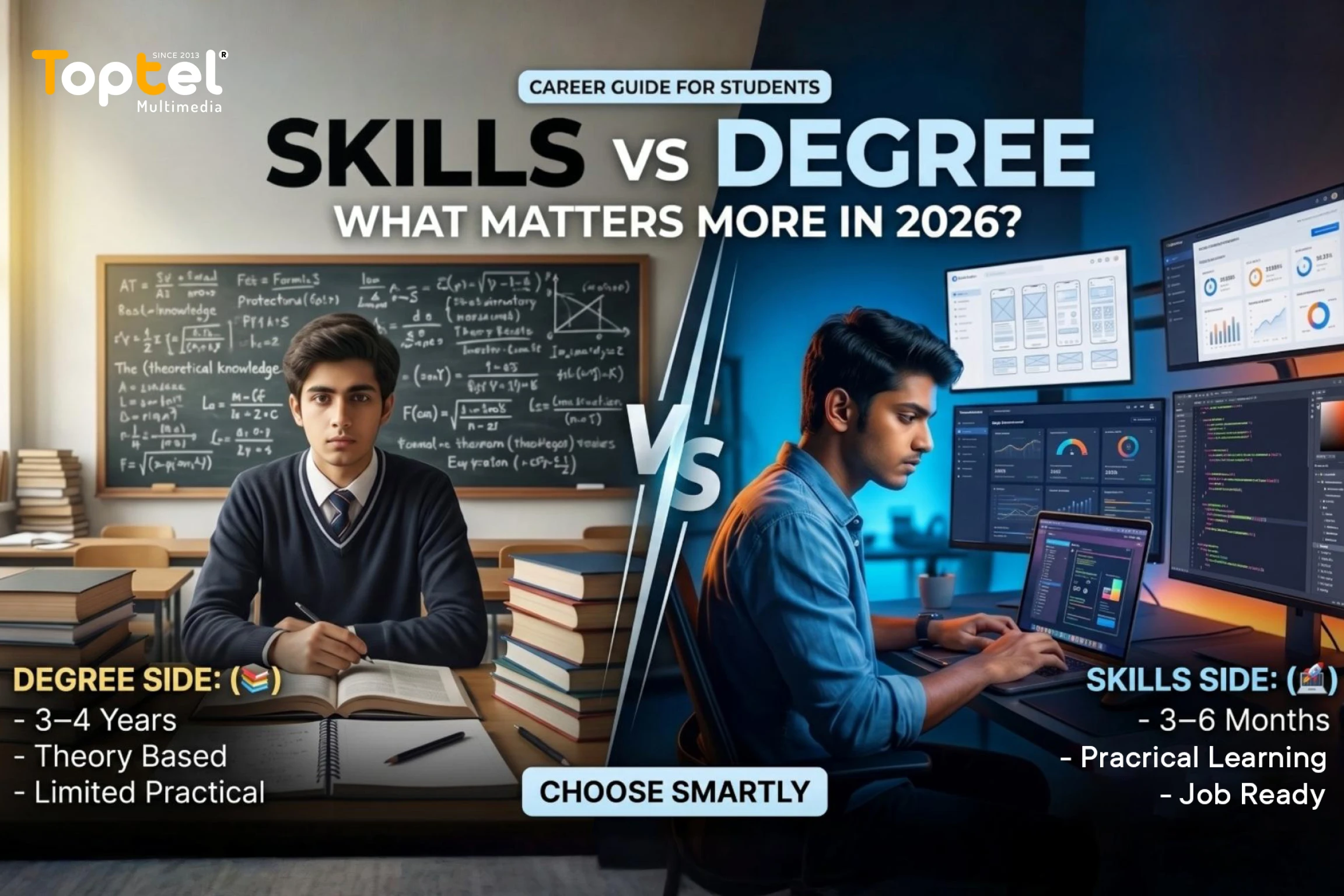
Is Degree Still Important in 2026? Skills vs Degree Explained
You have probably heard it a hundred times — “Beta, pehle degree le lo.” But you have also seen 22-year-olds making great money as freelancers, designers, or digital marketers — without a fancy degree on their wall.
So which path is actually right for you? This is one of the most confusing decisions a student faces in 2026. The job market has changed dramatically. Companies like Google, Apple, and even Indian startups no longer require a degree for many roles. What they want is proof that you can do the work.
In this blog, we break down the Skills vs Degree in 2026 debate honestly — no fluff, no bias — so you can make a smart decision for your future.
1. Traditional Degree: What It Offers
A college degree — whether it is a B.Com, BCA, BA, or B.Sc — has been the standard path for decades. And it does come with some real advantages. Let us be fair about what a traditional degree actually gives you:
- Foundational knowledge: A degree builds your base in a subject — be it commerce, science, or arts — and teaches you how to think systematically.
- Credibility: For many families, employers, and government bodies, a degree is still a stamp of credibility.
- Time for growth: Three to four years of college gives you time to mature, build networks, and figure out your interests.
- Gateway for some fields: If you want to be a doctor, engineer, lawyer, or civil servant, a degree is non-negotiable.
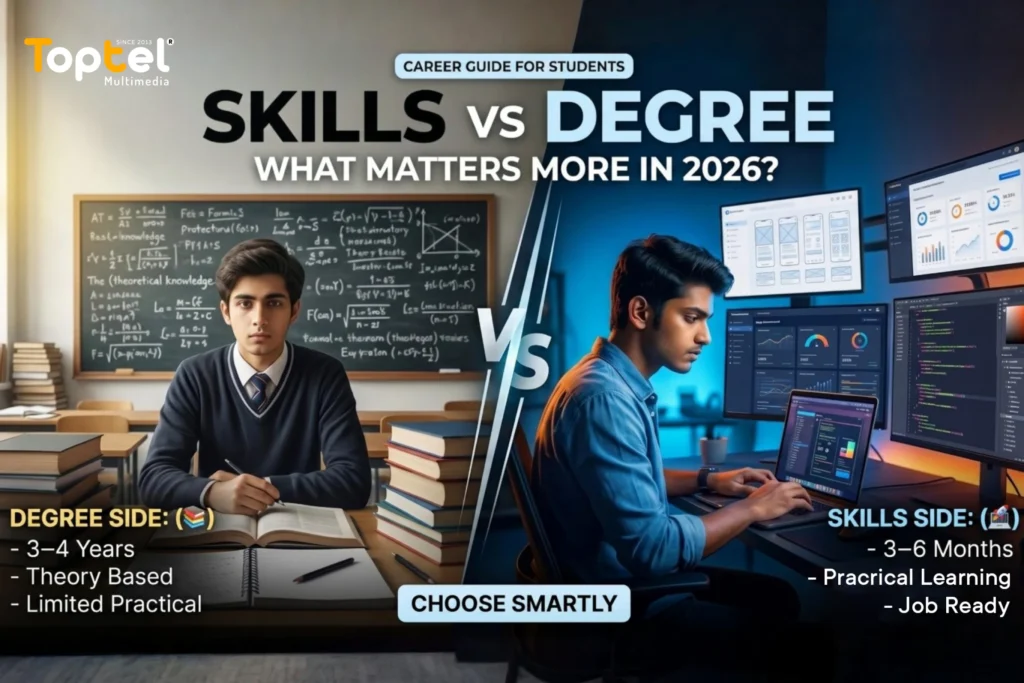
The challenge? Most degree programs are still teaching theory that was relevant 10–15 years ago. They are slow to update, expensive, and often leave students graduating with knowledge but zero practical skills for today’s job market.
3–4 yrs
Duration of most degrees
₹2–10L
Average total cost
~40%
Graduates struggle to find jobs in their field
2. Skill-Based Learning: What It Means
Skill-based learning is exactly what it sounds like — you learn a specific, practical skill that employers or clients are willing to pay for. Think digital marketing, web development, graphic design, or video editing.
These are not long, theory-heavy programs. They are focused, hands-on courses that can be completed in 3 to 6 months. You learn by doing — running real campaigns, building real websites, designing real creatives.
- Short duration: Most quality courses take 3–6 months to complete.
- Lower cost: A good skill-based course costs a fraction of a 3-year degree.
- Job-ready faster: You can start applying for jobs or freelance gigs within months of learning.
- Portfolio over paper: You graduate with a real portfolio — actual work that shows employers what you can do.
In a world where companies are increasingly focused on output over credentials, job-oriented skills are becoming the new currency.
3. Skills vs Degree: Key Differences
Let us put both options side by side so you can see exactly what you are choosing between:
Factor | 🎓 Degree | ⚡ Skill Course |
Duration | 3–4 years | 3–6 months |
Cost | ₹2 lakh – ₹10 lakh+ | ₹5,000 – ₹40,000 |
Job readiness | Mostly theory, low practical | Hands-on, portfolio-ready |
Flexibility | Fixed schedule, campus required | Online/offline, flexible batches |
Employer value (digital roles) | Moderate | High — skills + portfolio |
Freelance potential | Low | Very high |
4. What Companies Prefer in 2026
The hiring landscape has changed dramatically. Global companies like Google, IBM, Apple, and Tesla removed degree requirements from many of their job listings years ago. In India, hundreds of startups and digital agencies are now hiring based on portfolios, skills, and real experience — not just certificates.
Here is what hiring managers are actually looking for in 2026:
What companies want
A strong, updated portfolio
Proof of real project work
Problem-solving ability
Proficiency in industry tools
Communication and initiative
What matters less now
College name or percentage
Theory-based exams
Memorised textbook answers
Years spent in college
Degree for non-regulated roles
The bottom line on Skills vs Degree in 2026? For most digital and creative careers, your portfolio and practical skills will get you hired faster than any degree certificate ever will.
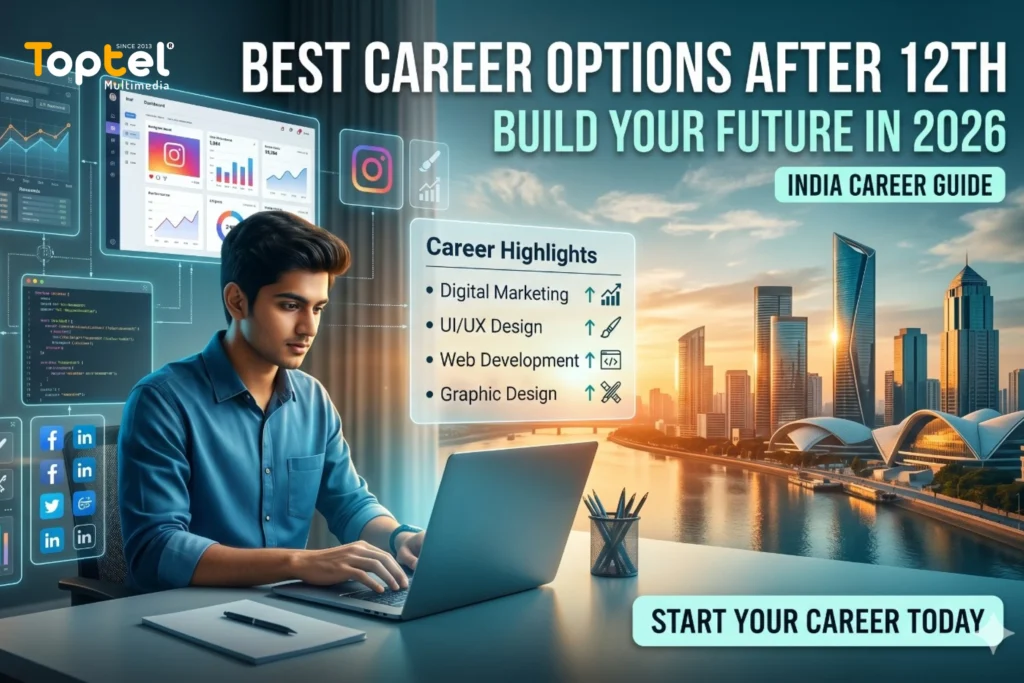
5. Career Options Without a Degree
Here are some of the most in-demand career without degree paths that students in Surat and across India are building right now:
📈 Digital Marketing
Run ads on Google and Instagram, manage SEO, and grow brands online. The Digital Marketing Course in Surat at Toptel Multimedia is one of the most popular starting points for students.
Most In-Demand
🎨 UI/UX Design
Design apps and websites that users love using Figma and prototyping tools. One of the highest-paying creative careers you can start without a degree.
High Salary
🖼️ Graphic Design
Create logos, social media graphics, and brand identity using Photoshop and Canva. A skill you can start freelancing with within weeks of learning.
Freelance-Ready
💻 Web Development
Build websites and web apps using HTML, CSS, and JavaScript. One of the most consistently well-paying job-oriented skills you can learn in 2026.
Top Paying
🌐 Freelancing
Combine any digital skill with platforms like Fiverr, Upwork, or LinkedIn and build your own client base. Many Surat students earn ₹30,000–₹80,000/month freelancing from home.
6. When a Degree is Still Important
Let us be honest — for some career paths, a degree is not optional. It is the law. Here are fields where you simply cannot skip the formal education route:
🏥 Medical / Healthcare
MBBS, BDS, nursing, and pharmacy require formal degrees regulated by government bodies. No shortcuts here.
⚖️ Law
To practice as a lawyer in India, you must complete an LLB or BA-LLB degree and pass the bar council enrollment.
🏗️ Engineering (Core)
Civil, mechanical, electrical, and other core engineering roles in government or infrastructure require a B.Tech degree.
🏛️ Government Jobs
Most UPSC, SSC, and state government positions still require a degree as a minimum eligibility criteria.
If your goal is one of these paths, a degree is non-negotiable. But if you are heading into the digital world — marketing, design, development, or content — your skills and portfolio will carry you much further than your marksheet.
7. Best Approach: Combine Skills + Degree
Here is the smartest strategy for 2026 — and it is simpler than you think. You do not have to choose between a degree and skills. You can do both.
- Pursue your degree — but do not stop there. If you are already enrolled in a college program, stay with it. A degree never hurts. But use your evenings, weekends, and summer breaks to build a practical skill on the side.
- Enroll in a focused skill-based course. A 3–6 month course in digital marketing, design, or web development alongside your degree will make you 10x more employable than your batch mates who only have a degree.
- Build your portfolio while you study. Take on small freelance projects, volunteer for local businesses, or create personal projects. Every piece of real work you produce adds to your portfolio and your confidence.
- Upskilling is the real degree of 2026. The market evolves fast. A person who keeps learning new tools and techniques will always stay ahead. One skill-based course is not the end — it is just your launchpad.
The students who combine a degree with strong practical skills are the ones companies compete to hire. Do not see it as either-or. See it as both — and give yourself every possible advantage.
Frequently Asked Questions
Can I get a job without a degree?
Yes — and it is becoming more common every year. In fields like digital marketing, graphic design, UI/UX, video editing, and web development, companies hire based on your skills and portfolio, not your degree. Many students from Surat have landed their first jobs or built successful freelance careers without completing a traditional degree. The key is having proof of your work — a strong portfolio and practical experience.
Which is better — skills or a degree?
The honest answer is: it depends on your career goal. For medical, law, engineering, or government jobs — a degree is essential and cannot be skipped. But for digital and creative careers, skills and a strong portfolio will take you further, faster, and at a fraction of the cost. The best approach in 2026 is to combine both — pursue your degree while actively building job-oriented skills alongside it.
What skills are most in demand in 2026?
The most in-demand skill-based courses in India right now include Digital Marketing, UI/UX Design, Web Development, Graphic Design, Video Editing, Data Analytics, and Content Creation. These fields have the highest job openings, fastest salary growth, and the most freelance opportunities. Starting with even one of these skills can open multiple doors within just a few months of dedicated learning.
Conclusion
The Skills vs Degree in 2026 debate does not have a single right answer — it depends on where you want to go. A degree still has value, especially in regulated professions. But for the majority of today’s fastest-growing digital careers, your skills, your portfolio, and your ability to deliver real results matter far more than the college you attended. The smartest students in 2026 are not choosing one over the other — they are building skills while pursuing their degree, starting early, staying consistent, and entering the workforce with both credentials and competence. Do not wait for graduation to start. Start building your skills today.